DWELL BEYOND THE ORDINARY
Choosing a global window supplier is not just a price comparison. Product construction, tested performance, finish options, lead times, and after-sales support all shape the final result. Aluminum Clad Windows often pair a weather-resistant aluminum exterior with a warmer interior finish, but designs differ between manufacturers. Buyers should confirm the exact materials and system details.
Performance deserves careful attention. The U.S. Department of Energy’s Energy Saver guidance estimates that windows account for 25%–30% of residential heating and cooling energy use. That figure applies to windows generally, not to every aluminum-clad product. Actual results depend on glazing, frame design, installation quality, climate, and building use. Small details matter.
This guide introduces ten suppliers for global buyers, with attention to product range, customization, documentation, and international support. A supplier’s catalog can look impressive; verified test reports and project references offer more useful evidence. Compare whole-window ratings where available, and ask how products perform in the intended climate. Check warranty terms and replacement-part availability, too.
There is no universal winner. A strong fit for a coastal residence may not suit a high-rise project or a tight delivery schedule. Supplier capabilities and certifications can also vary by market, so verify claims directly and request current documentation. This shortlist is a starting point, not a procurement guarantee. Even careful comparisons leave room for surprises.
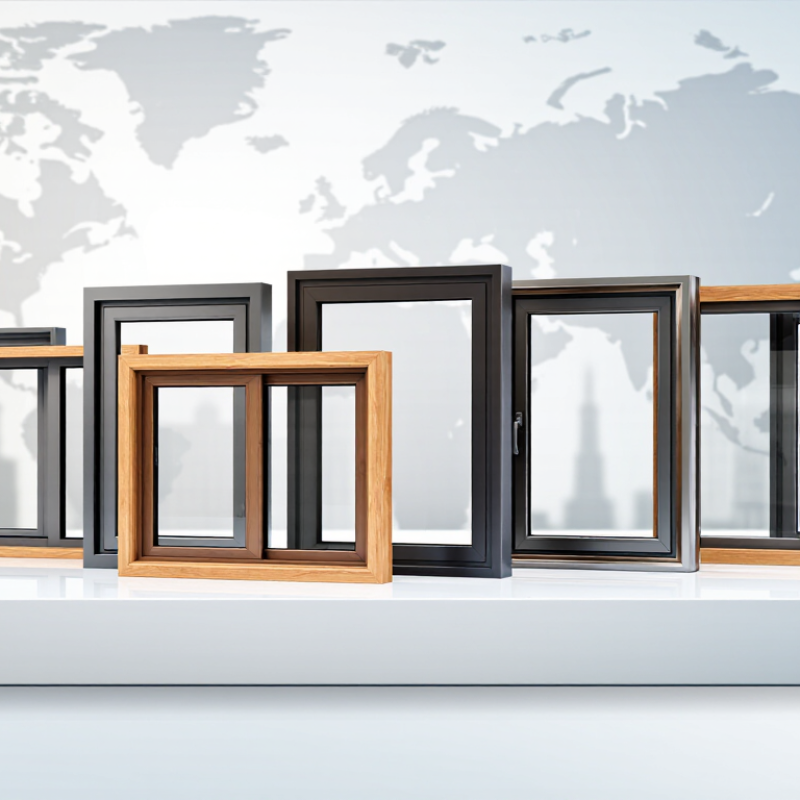
An aluminum-clad window typically pairs a wood interior with an aluminum exterior. The wood side brings a warm, paintable or stainable surface into the room. The outer aluminum cladding shields much of the frame from rain, sun, and repeated repainting. It is not an all-aluminum window: wood remains an important structural and insulating component.
Core construction varies by product. Some frames use solid wood; others use engineered wood made from bonded layers for more consistent dimensions. Certain designs add insulating materials or cavities, but these details differ by manufacturer and window series. Ask for a cross-section, not just a surface description. Small details matter. A thermal break, where included, can reduce heat transfer through metal components, while well-designed drainage paths help move water back outside. Cladding edges and joints deserve a close look, since poor detailing may allow moisture to reach the wood.
For global buyers, compare the full frame-and-glass assembly rather than judging the aluminum finish alone. Check stated thermal and air-leakage performance for the exact size and configuration. Also confirm how the interior wood is finished and maintained. A dark exterior may look crisp on a sample, yet perform differently under strong sun. I would not assume every aluminum-clad frame needs no upkeep; seals, finishes, and drainage still need periodic inspection.
When comparing aluminum-clad window suppliers, request NFRC-rated whole-window U-factor and SHGC values for the exact size and configuration you plan to buy. U-factor measures heat transfer; lower values generally indicate better insulation. SHGC, rated from 0 to 1, estimates how much solar heat passes through the window. A low U-factor is not the whole story.
Match the numbers to the building. A sunny room with large south-facing windows may need a different SHGC target than a shaded, north-facing room. Ask suppliers for the rating label or technical sheet, and check frame material, glazing, spacer, and operating style. These details affect performance. Small differences matter.
Compare like with like. A rating for fixed glazing may not represent an operable unit, and glass-only figures are not equivalent to whole-window ratings. Check the label. If a supplier cannot provide the relevant NFRC data, ask why before ranking its offer. Also confirm the quoted value applies to the product being priced, not merely a similar model. Climate, orientation, and shading all influence the right choice; even careful comparisons can miss a site-specific issue. That is worth revisiting before final selection.
NFRC U-factor and SHGC screening benchmarks by U.S. climate zone
These are ENERGY STAR Version 7.0 qualification criteria, not ratings for individual suppliers or products. U-factor values are maximums; SHGC criteria are minimums where marked ≥ and maximums where marked ≤. Northern-zone windows have no SHGC threshold in this table. Compare each supplier’s NFRC-certified rating for the exact frame, glazing, and product configuration before making a shortlist.
Sources: ENERGY STAR residential windows criteria · NFRC Certified Products Directory
For global buyers, a window’s test paperwork matters as much as its finish. Ask suppliers for reports referencing AAMA/WDMA/CSA 101/I.S.2/A440, the North American standard used to classify fenestration performance. Check the product type, operating style, size, and performance grade listed. A result for a fixed window does not automatically apply to a casement in the same product line. Details matter.
For air leakage, ASTM E283 measures airflow through a specimen under a stated pressure difference. Review the tested pressure, leakage rate, sample dimensions, and laboratory report—not just a brochure claim. A low leakage figure can be useful, but only when the test configuration matches the window you plan to buy. Ask whether the test covered the same sash, seals, and hardware. Small changes can matter.
Laboratory results are not a promise that every installed window will perform identically. Site conditions, frame alignment, and perimeter sealing affect real-world results. Request the report’s date and standard edition, then confirm that the quoted configuration matches the tested one. If a supplier cannot explain a rating plainly, pause and ask for clarification. I would also compare like with like; that step is easy to overlook.
A useful ten-supplier shortlist should compare regional strengths, not just catalogue photos. North American suppliers often offer custom sizes and thermally broken frames. Canadian firms may emphasize triple glazing for cold climates. German manufacturers commonly focus on precision hardware and low heat loss. Scandinavian suppliers often pair aluminum exteriors with timber interiors. Italian producers may offer slim sightlines and varied finishes. Turkish suppliers can provide broad export ranges at different price levels. Chinese factories often support high-volume orders and many profile options. Indian suppliers may adapt systems for hot, humid conditions. Gulf-region firms often prioritize solar control and dust-resistant seals. Australian suppliers may provide products tested for demanding wind conditions.
Product range matters as much as regional reputation. Compare fixed, awning, casement, and sliding units, then check glass thickness, drainage paths, and finish choices. Ask for test reports covering air leakage, water penetration, and structural performance. Quality-management and environmental certificates can help, but verify their scope, issuer, and current validity. Requirements vary by destination market. A polished brochure is not proof. Some buyers, including experienced ones, overlook replacement hardware availability; that can become an expensive delay.
Tips: Request a sample corner section and inspect its joints, coating, and thermal break. Ask suppliers to confirm lead times, warranty terms, and packing methods in writing. Match test evidence to your project’s climate and local requirements. Details matter. A shortlist can still miss a good regional supplier, so keep room for careful reassessment.
These are anonymous, region-based sourcing profiles—not verified rankings or claims about specific companies. Standards and marks below are relevant market requirements or evaluation frameworks to check; they do not indicate that any unnamed supplier holds a particular certificate. Confirm the exact product, test report, certificate scope, and current local requirements directly with each supplier.
| Profile | Sourcing region | Typical product range to investigate | Relevant standards or evaluation frameworks | Buyer due diligence |
|---|---|---|---|---|
| 01 — North American systems supplier | United States and Canada | Wood-frame windows with exterior aluminum cladding; fixed, casement, awning, and tilt-turn formats; custom sizes and glazing options. | North American Fenestration Standard (AAMA/WDMA/CSA 101/I.S.2/A440), where applicable; NFRC ratings for whole-product U-factor and solar heat gain; ENERGY STAR qualification where available for the product and market. | Request performance ratings for the precise configuration and size. Verify whether ratings cover the selected glass, frame, hardware, and operating style. |
| 02 — Central European timber-aluminum specialist | Germany, Austria, and neighboring Central European markets | Timber interior frames with aluminum exterior protection; inward-opening, tilt-turn, fixed, and balcony-door formats; multiple timber and finish options. | EN 14351-1 product-performance framework for applicable external windows and doorsets; CE marking and the required Declaration of Performance under applicable EU construction-product rules. | Check the Declaration of Performance, intended use, declared performance characteristics, and whether the tested construction matches the offered product. |
| 03 — UK and Ireland project supplier | United Kingdom and Ireland | Made-to-measure timber-aluminum windows and doors for residential renovations and new-build projects; common formats include casement, tilt-turn, and fixed glazing. | Applicable UK or EU construction-product marking and declaration requirements; project specifications may also refer to relevant BS EN performance standards. | Confirm which regulatory regime applies at the project location and import date. Ask for current declarations, test evidence, installation guidance, and warranty terms. |
| 04 — Nordic climate-performance supplier | Sweden, Finland, Norway, and Denmark | Insulated timber-aluminum windows and glazed doors designed for cold-climate applications; fixed, side-hung, and inward-opening configurations may be available. | Applicable EN 14351-1 declarations in EU markets; national building-energy and safety requirements; project-specific thermal, air-leakage, water-tightness, and wind-load evidence. | Compare whole-window thermal performance rather than glass-only values. Check condensation, ventilation, and installation details for the local climate zone. |
| 05 — Eastern European export manufacturer | Poland, the Baltic states, and neighboring markets | Timber windows with external aluminum cladding, often offered in standard and made-to-order sizes; options may include different wood species, glazing, and surface finishes. | EN 14351-1 and applicable EU Declaration of Performance and CE-marking requirements for products within scope. | Verify factory quality controls, traceability, packaging for export, lead times, replacement-part availability, and the precise scope of product test reports. |
| 06 — East Asian specification supplier | Japan and South Korea | Residential and commercial window systems, including thermally improved frames and project-specific configurations; confirm whether timber-aluminum clad products are made locally or supplied through import channels. | Japan’s JIS A 4706 applies to window products within its scope; confirm the applicable Korean product and building requirements with the local authority or project consultant. | Request documentation in the project’s required language and confirm that local testing covers the exact frame construction, glazing, and operating type. |
| 07 — China-based export supplier | China | Export-oriented window manufacturers may offer aluminum windows, timber windows, and selected timber-aluminum combinations; product availability varies by factory and project specification. | GB/T 8478 relates to aluminum windows and doors; it should not be treated as proof of compliance for a timber-aluminum hybrid unless the product and scope are explicitly covered. Destination-market standards also apply. | Audit the manufacturing site and request independent test reports for the exact hybrid assembly. Check that the report issuer, model, dimensions, and test configuration are identifiable. |
| 08 — Australian and New Zealand project supplier | Australia and New Zealand | Residential and architectural windows and glazed doors; ask specifically about locally available timber-aluminum clad configurations, coastal-grade finishes, and custom project sizes. | AS 2047 is a relevant Australian standard for windows and external glazed doors within scope. WERS provides window energy ratings in Australia; it is a rating scheme, not a general product certification. | Check wind-pressure and water-penetration evidence for the site exposure. Confirm energy-rating details, hardware suitability, and corrosion resistance for coastal locations. |
| 09 — Turkish and Mediterranean export supplier | Türkiye and Mediterranean export markets | Made-to-order windows and doors for residential and commercial projects; aluminum systems are common, while timber-aluminum clad availability should be confirmed for each manufacturer. | For applicable European-market products, review EN 14351-1 documentation and the required Declaration of Performance and CE marking. Verify destination-country requirements for other markets. | Confirm whether production is in-house or subcontracted, and obtain evidence for the exact product’s thermal, weather, and structural performance. |
| 10 — Gulf and wider Middle East project supplier | Gulf states and neighboring Middle Eastern markets | Project-oriented window suppliers commonly handle aluminum systems; timber-aluminum clad products may be imported or custom-specified. Check availability of solar-control glazing and high-temperature-compatible seals. | Applicable local building codes and project specifications govern. Where products are imported, request the relevant destination-market declarations and test evidence; ISO 9001 concerns quality-management systems, not product performance. | Assess solar heat gain, seal and hardware durability, sand and dust exposure, installation capability, spare parts, and after-sales support in the destination country. |
For global buyers, compare aluminum clad window suppliers by separating factory lead time from transit time. A custom color, unusual opening size, or triple-glazed unit can change the production schedule. Ask for a dated timeline covering drawing approval, fabrication, packing, and port dispatch. Get the assumptions in writing. A quoted “eight weeks” may not include approval delays or ocean freight, and that detail is easy to miss.
Warranty terms deserve the same close reading. Check whether coverage differs for frames, exterior finishes, hardware, and insulated glass. Ask how long a claim usually takes and what evidence is required; dated photos and shipment records may help. Clarify whether improper installation or coastal exposure affects coverage. A broad warranty headline can sound reassuring, but the exclusions often carry more practical weight.
Export support can reduce avoidable delays. Ask whether the supplier prepares packing lists, commercial invoices, crate labels, and installation drawings, and who answers technical questions across time zones. Request a sample export document set before placing a large order. Also confirm replacement-part availability and how damaged units are reported. A comparison sheet helps, though it can make uncertain schedules look more precise than they are. Be cautious about treating estimates as promises.
“I went to the woods because I wished to live deliberately, to front only the essential facts of life, and see if I could not learn what it had to teach, and not, when I came to die, discover that I had not lived.”
- Henry David Thoreau