
DWELL BEYOND THE ORDINARY

Choosing a reliable Steel Wire Rod Manufacturer in China requires more than scanning a top-ten list. A supplier may look impressive online, yet its real performance appears in mill records, product consistency, and delivery discipline. Steel wire rod serves demanding industries, including fasteners, welding wire, springs, tire cord, and construction products. Each application needs different chemistry, surface quality, tensile strength, and drawing performance.
This guide reviews ten notable Chinese manufacturers through practical purchasing criteria. These include production capacity, steel grades, coil weight, diameter tolerance, packaging, export experience, and quality certifications. Buyers should examine mill test certificates, heat numbers, inspection procedures, and traceability from billet to finished coil. A dependable producer should explain its equipment clearly, not hide behind broad marketing claims. Factory audits, video inspections, and independent testing can reveal details that brochures often miss.
The ranking should not be treated as permanent. Market conditions, equipment upgrades, and service quality can change. Some public information may also be incomplete or difficult to verify. That is worth remembering. A lower-ranked factory might fit a specialized order better than a famous group. Conversely, a large manufacturer may still disappoint if communication is slow or tolerances are poorly controlled. Before signing a contract, compare samples, technical datasheets, production lead times, payment terms, and after-sales support. The best choice balances verified quality, stable supply, transparent communication, and total cost. A careful buyer measures more than price.
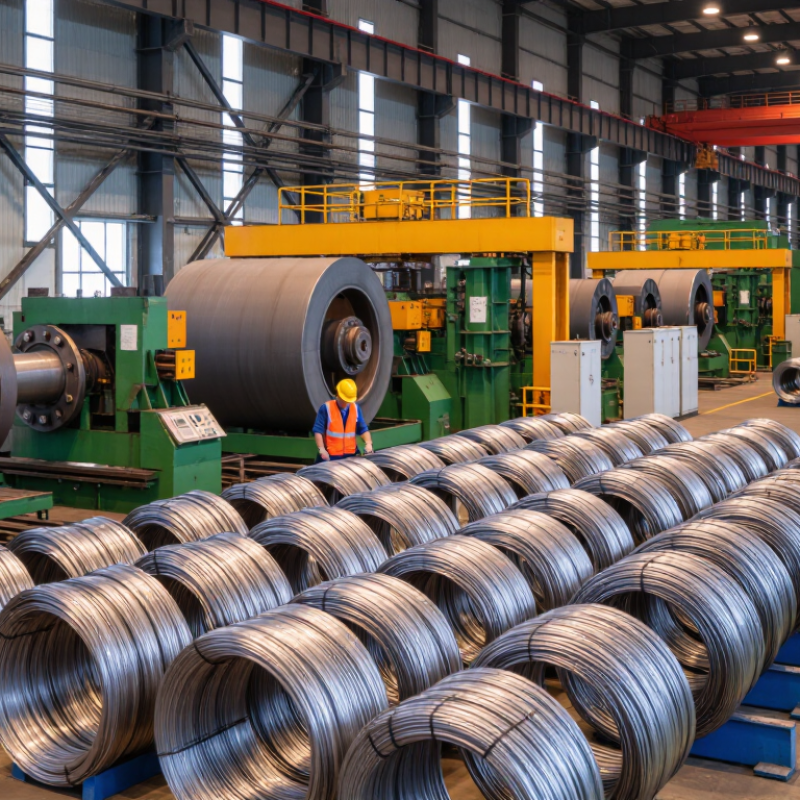
Steel wire rod is a hot-rolled, semi-finished steel product supplied in coils. It commonly becomes welding wire, fasteners, mesh, springs, and tire cord. Its quality depends on carbon content, surface condition, diameter tolerance, and internal cleanliness.
Manufacturer selection matters because small chemistry shifts can change drawing performance. World Steel Association data reported 1,888.2 million tonnes of crude steel production in 2023. Its April 2024 Short Range Outlook expected global steel demand to grow by 1.7% in 2024. This expanding market increases pressure on mills, logistics, and quality control. A reliable producer should provide mill certificates, heat numbers, inspection records, and consistent test results. Ask about tensile strength, reduction of area, decarburization, and surface defects. A low price may look attractive, but hidden rework costs can quickly erase the saving. No supplier scorecard is perfect. Review it after every shipment.
Tips: Request a trial coil before signing a large contract. Compare three samples from different heats, not one polished report. Check whether the manufacturer supports independent inspections and responds clearly to nonconformities. Verify production capacity against your monthly demand. Also examine energy and emissions disclosures; the International Energy Agency identifies steel as a major industrial emissions source, making transparent production data increasingly valuable. References from similar applications can reveal practical problems that brochures often miss.
Steel wire rod is a hot-rolled, coiled steel semi-finished product commonly used to manufacture wire, fasteners, mesh, springs, welding products, tire cord and other downstream components. The following table provides a practical, company-neutral framework for comparing a Top 10 shortlist.
| No. | Selection Dimension | Realistic Industry Data or Benchmark | Why It Matters | Documents or Checks to Request |
|---|---|---|---|---|
| 1 | Product Diameter Range | Common commercial wire-rod sizes include approximately 5.5–16 mm in diameter. Some mills supply smaller or larger sizes depending on rolling equipment and product grade. | The correct diameter reduces downstream drawing passes, material loss and tooling adjustments. | Product catalogue, dimensional range, mill capability statement and sample inspection report. |
| 2 | Applicable Product Standards | Common reference standards include ASTM A510/A510M, EN 10016, ISO 16120 and JIS G3505/G3506. The applicable standard must match the ordered steel grade and end use. | Standards define requirements for chemical composition, dimensions, mechanical properties, testing and surface quality. | Purchase specification, standard edition, certificate of conformity and third-party test comparison where required. |
| 3 | Chemical Composition Control | Typical reported elements include carbon, manganese, silicon, sulfur and phosphorus. Alloy grades may also specify chromium, nickel, molybdenum, boron or other elements. | Chemistry affects strength, ductility, weldability, drawability, heat-treatment response and corrosion performance. | Heat analysis, product analysis, spectrometer records and a comparison between specified limits and actual values. |
| 4 | Dimensional Tolerance and Ovality | Diameter tolerance and ovality are grade-, size- and standard-dependent. Acceptance should be based on the tolerance stated in the purchase order rather than on a universal value. | Stable dimensions improve drawing speed, reduce die wear and help maintain consistent final wire dimensions. | Calibration records, dimensional inspection data, coil sampling plan and actual measurements at multiple positions. |
| 5 | Mechanical Properties | Relevant properties may include tensile strength, yield strength, elongation and reduction of area. Required values vary significantly by carbon level, alloy design, diameter and delivery condition. | Mechanical consistency determines whether the rod can be drawn, formed, welded or heat-treated without excessive breakage. | Tensile-test results, sampling frequency, test temperature, test method and batch-to-batch statistical records. |
| 6 | Surface Quality | Wire rod should be checked for defects such as seams, laps, cracks, slivers, excessive scale and harmful rolled-in imperfections. The permitted condition depends on the applicable standard and end use. | Surface defects can become fracture points during drawing, galvanizing, welding or cold forming. | Visual inspection procedure, surface-defect acceptance criteria, descaling or pickling requirements and inspection photographs. |
| 7 | Coil Weight and Packaging | Commercial coil weights commonly fall around 1–2.5 metric tons, although the actual range depends on the mill, diameter and handling system. Coils should be secured and protected against transport damage and contamination. | Coil weight affects unloading equipment, storage capacity, production line compatibility and handling cost. | Coil-weight tolerance, inner and outer diameter, coil height, banding method, labels and moisture-protection details. |
| 8 | Traceability and Inspection Documents | A complete traceability system should connect each coil to its heat number, production date, grade, dimensions and test results. EN 10204 Type 3.1 inspection certificates are commonly requested for controlled industrial supply. | Traceability supports incoming inspection, nonconformance analysis, regulatory compliance and customer audits. | Sample mill test certificate, heat-number marking, packing list, inspection plan and certificate-verification process. |
| 9 | Production Consistency and Supply Capability | Compare recent delivery records, repeat-order performance, capacity allocation, production scheduling and the supplier’s ability to maintain the same grade and dimensions over time. | Consistent supply is essential for continuous drawing, fastener, welding and construction-material production. | Twelve-month delivery history, production lead-time commitment, capacity statement, contingency plan and quality-performance data. |
| 10 | Total Landed Cost and Technical Support | Evaluate more than the quoted metric-ton price. Include freight, packaging, inspection, tariffs, payment terms, yield loss, rejection risk and technical support. | A lower purchase price may be offset by higher processing loss, inconsistent quality, delayed delivery or additional inspection costs. | Itemized quotation, shipping terms, sample approval plan, complaint-response time, replacement policy and total-cost calculation. |
Selection Tip
Rank shortlisted manufacturers using weighted criteria such as product conformity, surface quality, traceability, delivery reliability and total landed cost. Numerical requirements should always be confirmed against the applicable grade, standard, diameter and end-use specification.
“I went to the woods because I wished to live deliberately, to front only the essential facts of life, and see if I could not learn what it had to teach, and not, when I came to die, discover that I had not lived.”
- Henry David Thoreau